
CHAPTER 43:07 – STANDARDS: SUBSIDIARY LEGISLATION
INDEX TO SUBSIDIARY LEGISLATION
BOBS Standards Mark Regulations
Standards (Compulsory Standards) Regulations
BOBS STANDARDS MARK REGULATIONS
(sections 16 and 11(1))
(15th March, 2002)
ARRANGEMENT OF REGULATIONS
REGULATION
1. Citation
2. Declaration of a standards mark
S.I. 13, 2002.
These Regulations may be cited as the BOBS Standards Mark Regulations.
2. Declaration of a standards mark
The following mark is hereby declared to be a BOBS standards mark that may be applied to any commodity falling within the standards specifications which have been set and issued in respect of that commodity,
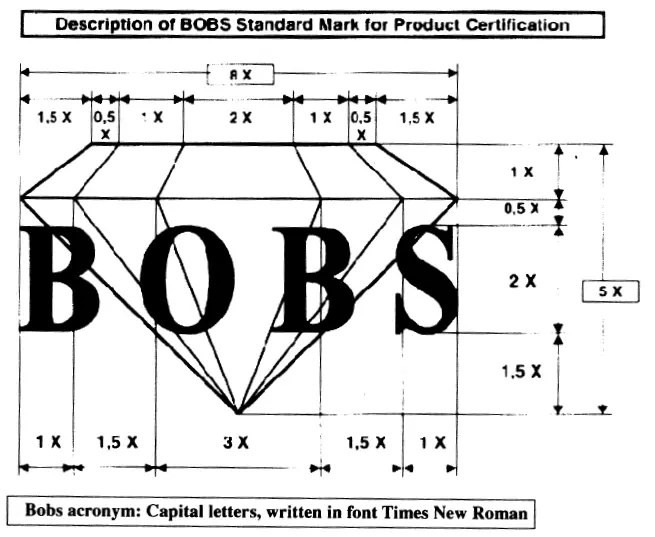
BOBS Standard Mark (for Product Certification) is a stylised representation of a diamond with the acronym “BOBS” imposed (in Times Roman capital letters) on the lower part of the diamond.
CONSTRUCTION OF THE STANDARD MARK
The diamond consists of a crown and base each displaying five facets which are symmetrically constructed to the outer dimension of 5X (height) by 8X (length).
The crown is a set of five centrally aligned polygons with the height of 1X apart. The line 5X long is marked at points 0.5X and 1.5X from each end. The Line 8X long is marked at points 1X and 2.5X from each end. The ends of the two lines and the two sets of points are joined by straight lines.
The base is a set of five triangles made by locating a centrally aligned point 4X vertically below the 8X line, and joining that point to the 8X line at the ends and at points 1X and 2.5X from each end.
The size of the letters varies according to the horizontal length of the diamond. The height of the letters is 2X. The top of the letters is 0.5X from the 8X horizontal centre line of the diamond.
The lines shall be 0.1X thick.
STANDARDS (COMPULSORY STANDARDS) REGULATIONS
(section 16(1)(f) and (g))
(23rd June, 2023)
ARRANGEMENT OF REGULATIONS
REGULATION
1. Citation
2. Interpretation
3. Objective
4. Scope
5. Application of WTO/TBT Agreement Principles
6. Use of international principles
7. Functions of the Bureau
8. Delegation of functions
9. Compliance with Regulations
10. Appointment of inspection agencies
11. Application for certificate of compliance
12. Handling of an application
13. Remote inspection
14. Products bearing the standards mark
15. Destination inspection
16. Conditional release
17. Locally manufactured products
18. Service standards
19. Disposition of samples
20. Lost certificates
21. Mutual recognition of conformity assessment procedures of other countries
22. Market surveillance
23. Revocation of certificate
24. Retaining technical documentation of compliance and confidentiality
25. Dealing with non-complying products
26. Exemptions
27. Appeals
28. Revocation of S.I. No. 78 of 2008
S.I. 78, 2008,
S.I. 60, 2023,
S.I. 71, 2023,
S.I. 48, 2024.
These Regulations may be cited as the Standards (Compulsory Standards) Regulations.
In these Regulations unless the context otherwise requires—
“authorised officer” means an employee of the Bureau designated as such by the Managing Director to conduct inspection, sampling, testing or evaluation of a product to determine its conformity with the compulsory standards;
“bill of lading” means a document issued by a carrier acknowledging that specified goods have been received on board a vessel as cargo for conveyance to a named place for delivery to a known or identifiable consignee;
“certificate of conformity” means a verifiable document issued by an inspection agency which is proof that the product specified therein conforms to the compulsory standard;
“competent authority” means an organisation that has been legally delegated or invested with authority, capacity or power to develop and enforce standards and technical regulations in a country;
“certificate” means certificate of compliance or conditional release certificate or registration certificate;
“certificate of compliance” means a certificate issued by the Bureau, verifying compliance of an imported batch or product with these Regulations;
“certification” means the formal substantiation that a product, process, organisation, individual or management system meets the requirements of a standard or technical regulation;
“compulsory standard” means a Botswana Standard that has been declared compulsory in terms of the Act;
“conditional release certificate” means a certificate issued by the Bureau to an importer allowing the release of an imported commodity from the custody of Customs officials after compliance with customs requirements while awaiting approval by the Bureau;
“conformity assessment” means a procedure used, directly or indirectly, to determine that the relevant requirements of the compulsory standards are fulfilled;
“CIF” value means the cost, insurance and freight value;
“inspection” means examination of a product design, product,…
Members-only content